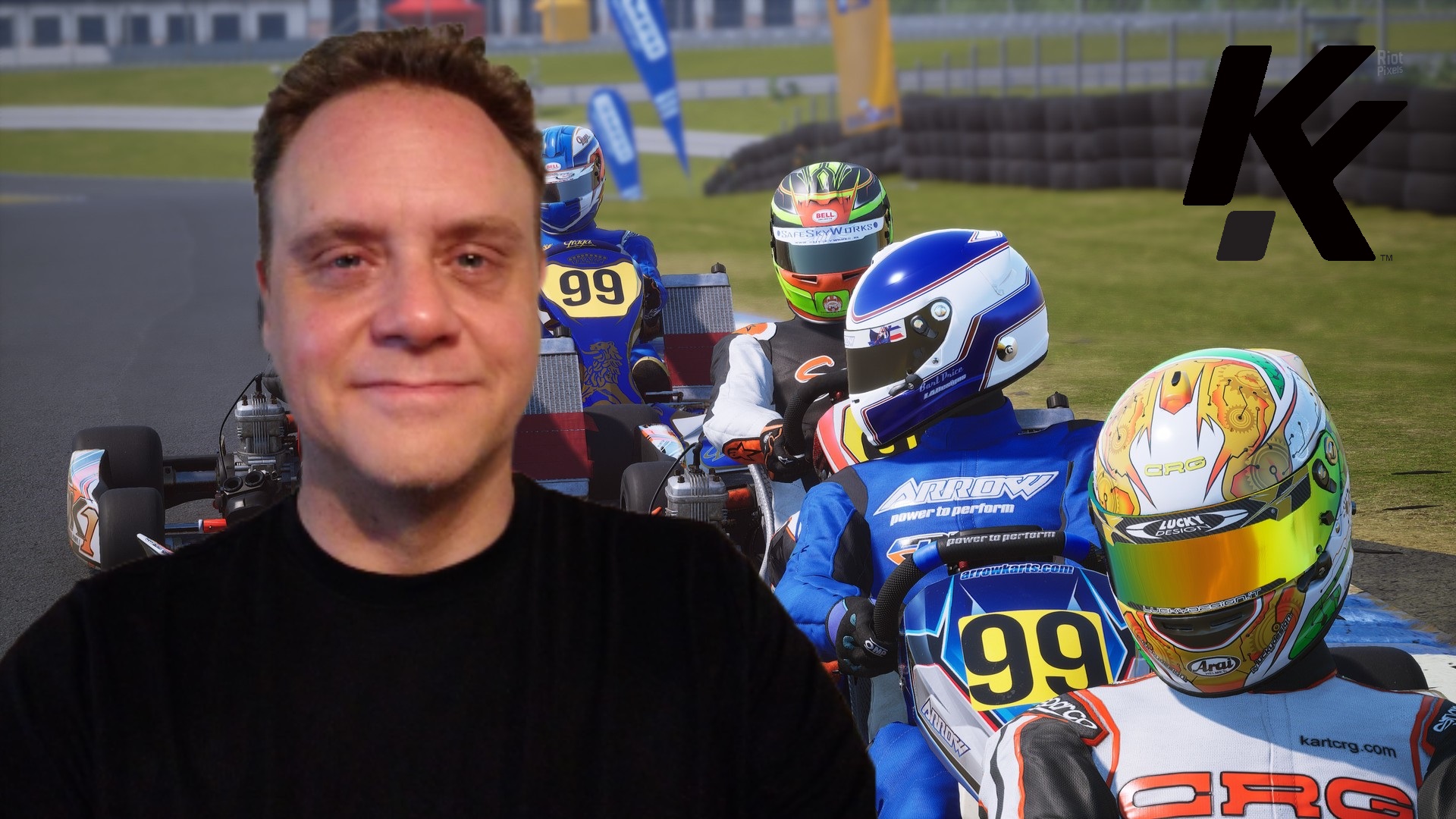
Ladies and gentlemen, today we have the absolute thrill of being in the presence of Todd Wasson, a true maestro in the realm of vehicle simulation and physics programming! His passion for cars, physics, and programming is nothing short of infectious, and it has catapulted him into the forefront of the video game industry since the late ’90s. With a captivating career boasting exceptional titles like “Virtual RC Racing,” “KartKraft,” “Racecraft,” “The Grand Tour Game,” and “Nascar ’21: Ignition,” Todd has left an indelible mark on the gaming landscape.
Can you tell us a bit about your background and how you got started with Performance Simulations?
I’ve been a professional physics engine and vehicle simulation model programmer in the video game industry since 1999 or 2000 or so and dabbled in vehicle model programming as a hobby on and off for about ten years before that. Fourteen years of my career were spent on Virtual RC Racing (VRC) and VRC Pro (RC car racing simulations), with the rest spread out among other titles: “KartKraft”, “Design it Drive it: Speedboats”, “Racecraft”, “The Grand Tour Game”, and “Nascar ’21: Ignition”. On a few of these titles, I worked on AI and control systems among other aspects, and have written engine simulations, both predictive performance models and procedural audio simulation models.
How did your passion for cars, physics, and programming lead to the creation of the Straightline Acceleration Simulator?
I had a weird knack and interest in numbers and numerical prediction going as far back as I can remember all the way to childhood. As a little kid playing with Hot Wheels by myself, I’d frequently have a pencil, pad of paper, and a calculator next to me which I’d use to try to dream up ways of figuring out how fast my pretend cars were based on horsepower and whatever else. I had no idea what I was doing, but did my darndest to figure it out how horsepower related to how fast a car was. The equations I came up with were utter nonsense of course and of no use at all to anyone today, but I was trying to figure out physics on my own even at that age. I wish I could find some of those pages, they’d be funny to look at now. Guess it’s safe to say I was a pretty weird kid and am now a weird adult!
Fast forward to high school in 1991 when I was thrilled to finally take a physics class. In high school, my friends and I were gearheads that owned old muscle cars (or muscle car wannabees at least), mostly old Firebirds from the 1970s and similar cars. I wanted to figure out the most cost-effective way to make my car faster than theirs (imagining I actually had the money to do so, which I didn’t). Thanks to the physics class I learned the basics about positions, velocities, accelerations, and forces with Newton’s laws which was enough to get me thinking about it in a proper manner. I remember wanting to figure out how to calculate the 0-60 mph time of my car using what I’d learned in school, and set to work on it.
It occurred to me that if I started with a pretend/simulated car with engine rpm at idle, I could use the torque at that rpm to calculate how fast it would accelerate. Then assume constant acceleration for maybe one or two seconds and recalculate it all, then see how much time had passed by the time it hit 60 mph. I was doing that on paper with a pencil and calculator, so even calculating a few simulation steps like that took a long time. I remember laying on the carpet in front of the TV doing this when I realized that if I calculated it every second instead of every two or more seconds, the result got more accurate. Intuitively it made sense and I realized that the shorter those time steps were, the more accurate it could become.
I remember thinking “If only there was a way to calculate it lots of times, like 100 or 1000 times per second. But there’s no way, it would take years and piles of paper to do that.”
Then probably the happiest thought I ever had hit me: I looked over at the computer and realized that was exactly the thing to do, so I set to work writing a simple program to do the same thing. Sure enough, it worked, and the results were pretty accurate. From then on I was obsessively writing models like that including some not too terrible attempts at car engine simulation. This was all in an ancient programming language called QBasic on DOS.
I tinkered with that for several years, eventually moving from Minnesota to Arizona in about 1995. Somewhere in the late 1990s I picked up a compiler called PowerBasic DLL for Windows and rewrote that drag racing program so it’d build to an exe file and run over 100 faster that could be sold to customers. I wasn’t a very good programmer back then but it was easy enough to cobble together an actual Windows application. I named it Straightline Acceleration Simulator, registered a company called Performance Simulations, made a website for it, and started selling it by mail. It did terribly, but I learned a lot and did get a handful of sales that way. Either way, it was all pretty exciting.
After that I decided to see if I could go from a very simple one dimensional simulation (drag racing) to three dimensions (video games/road racing sims, etc..), so began banging my head on a wall to figure that out. There wasn’t much online to learn from back then so you were pretty much on your own if you wanted to do something like that. Eventually I did come up with something that worked (starting in 1999 if I remember right), got hooked up with some people that were developing an RC car simulator originally called Virtual RC Racing 2000 (later shortened to Virtual RC Racing 2.0, commonly shortened further to just “VRC”) and I was off to the races. I licensed that new physics engine to them and continued development for another 14 years.
What advancements or innovations in gaming technology have you witnessed throughout your career, and how have they influenced the development of your simulation games?
The first major one that comes to mind is the switch from single core machines to multiple cores (specifically dual cores) in the early 2000s. This meant we could run the expensive physics code on a separate thread (an extra CPU, essentially) which massively increased performance and enabled more computationally expensive, robust code to run at acceptable speeds. In other words, we can make the games/sims cooler. That was great for dual core machines, but today we have 16/32 machines if not better, plus we can do massively parallel operations on the GPU which may not have anything to do with graphics at all, so today it’s no longer a good design in my mind. Many engines still work that way today, unfortunately.
Another advancement that came to be even before that (when I first started working on VRC) was a graphics card (GPU) side thing: Hardware transform and lighting. I personally didn’t work with that as I wasn’t a graphics engine person back then, but the other programmer on VRC told me about it and had incorporated it into VRC. It was a good thing because it made the rendering cheaper, meaning again performance was increased (better frame rate) so it opened up computational space for more sophisticated logic and simulation code.
I’d say it’s all been driven mainly by the hardware geniuses designing CPUs and GPUs along with advancements in DirectX by Microsoft which went hand in hand. Every advance they make improves performance and enables us to pile in more cool stuff into games and simulations.
The Grand Tour Game presented a unique challenge of achieving arcade-style vehicle handling while using the rFactor 2 physics engine. Can you discuss your role in modifying the engine and creating control systems for this game?
There are as many answers to this as there are players. Everyone likes something different so it’s a hard question to give a clean answer to. I’m a die-hard simulation guy for the most part, meaning I like sims to drive as realistically as possible. Occasionally it’s fun to drive something less serious though. The die-hard simulation junkies like me want the cars to drive as much like the real cars as possible, while casual gamers prefer something that’s more like a caricature of a car than a real car so they can just relax on the couch with a gamepad and have some fun without having to concentrate too hard.
They’re really two different markets on a spectrum, “sim” on one side vs “arcade” on the other. In between is a whole range of titles across the “sim vs arcade” spectrum that lean a little more one way than the other but not quite at either extreme, often called “simcade.”
I’ve worked mostly on the sim side, but have also worked on the extreme arcade side (“The Grand Tour Game” was the most arcade of them all) and a couple of titles somewhere in between. The differences are interesting. On the physics side where I mostly live, you can approach them quite differently. For the arcade or simcade titles that need to run on an Xbox or Playstation with a gamepad that any kid can drive, I spent a great deal of time developing control systems that make the cars very easy to drive. When you want to go REALLY arcade, you can go further by adding fake forces and torques into the mix to force what would otherwise be a hardcore simulation engine to drive more like Mario Kart or whatever the developers want it to.
On the other side (the hardcore sim side), most of the focus is on making the physics engine itself accurate and robust enough, with lots of focus on tire modeling, aerodynamics modeling, and a zillion other similar things, then spending a great deal of time tuning the parameters to match the real vehicle performance and handling the best you can with whatever data you can find to validate it against (often not much). No fake forces and torques or any other cheating is allowed. So the physics development approaches to both sides of the spectrum can be quite different. It’s part of what makes all these racing titles so interesting. Different developers have different ideas and approaches to all of this and are catering largely to different players, so they all feel a little bit different from each other and perhaps scratch a different itch.
As a developer, what challenges do you face in balancing realism with accessibility in simulation games? How do you approach striking the right balance to cater to both hardcore simulation enthusiasts and casual gamers?
As a hardcore simulation guy, I care more about realism than accessibility. However, on titles where they wanted more accessibility, things like steering aids and perhaps some fake forces and torques added into the system can make driving easier than they otherwise would be. I only do this if the title absolutely requires it.
On “The Grand Tour Game” I added brake and steering assists along with lots of fake forces and torques to make the cars do impossible things with impossible performance and impossibly easy drifting, but somehow feel like a car in some sense anyway even though we’re really violating the laws of physics in some major ways to do it.
On “Nascar ’21: Ignition” there were no fake forces or torques to manipulate the vehicle response, but a NASCAR vehicle is impossible to drive via direct steering on anything other than a wheel (despite what many players seem to think), so there I wrote steering and brake assists in several different levels using different algorithms which feel completely different from each other. Mainly it was the steer assist helping if you had it turned on.
With it set on “high” it’d basically drive for you. That was meant for handicapped players primarily, but also benefited small kids so they could drive just using their trigger finger without even touching the steering.
The next level down was “medium” which was a pretty sophisticated control system that made things very easy to drive, but it takes away most of the feeling of the car so not everyone likes that.
Below that was “low” which was more like a constant rate steering system that kicked it up to “medium” if you got the car too far out of shape, then below that was “off.”
Of course what happens on release day is everyone immediately turns all the assists off completely before even hitting the track once, then they make videos complaining that the car is too hard to drive! Well duh, it’s a zillion horsepower stock car. You don’t really think you could drive one of those with a gamepad in real life, do you?
Players are funny sometimes, but we do what we can do to appease them all the best we can anyway. I’ve resigned myself to the fact that’s it’s not possible to make everyone happy all the time, but that’s probably about as close as you can get. On Nascar ’21, if you ran a steering wheel, the steer assists were always off regardless of your setting so you were really driving something very close to the level of rFactor.
With the rise of virtual reality (VR) and augmented reality (AR) technologies, how do you envision these technologies shaping the future of simulation games? Do you have any plans to explore these platforms in your upcoming projects?
I’m a huge VR nut. VR in my mind absolutely blows open the doors of what’s possible in terms of immersion, and the hardware just continues to get better over time. I had a Z-800 VR headset many, many years ago (long before Oculus and the rest came along). It was a terrible headset by today’s standards, but it was really cool and gave a glimpse into where things could one day go if the hardware geniuses can figure it out. When Oculus came onto the scene, a friend let me borrow his DK1 for a couple days and I was absolutely blown away. The field of view was enormous compared the Z-800 which looked about the same as a laptop screen sitting a couple feet in front of you. The Oculus had no perceivable lag either.
I remember thinking “They’ve finally nailed it. VR is really here now.”
It was just amazing. I immediately picked up a DK2 as soon as it came out, and now own several different VR headsets. I’ll own more in the future for sure. I can’t get enough VR!
So do I have plans on exploring those platforms for my upcoming projects? Absolutely yes. One of my sims “Design it, Drive it: Speedboats” already has for many years and was developed completely because of VR. I wanted that “flying a boat” feeling in VR and couldn’t find anything that really did the trick. I haven’t run a racing or flight sim outside of VR in years unless there’s no other option. If a title supports VR, I’m running it in VR. End of story!
Not everyone likes VR though, so at the same time, I’m working hard to support single and triple screens too.
AR is interesting too although I haven’t personally played with it and don’t have plans to any time soon. I think there’s potential with that though for people who have the fancy sim cockpits. Imagine being able to see your real sim cockpit, your real hands, steering wheel or flight yoke and control panel, etc., through the headset, but out the windscreen, you see the simulated world too. It’ll be interesting to see what the people working on that end up with.
Multiplayer gaming has become increasingly popular in recent years. Can you share any insights into how you incorporate multiplayer features into your simulation games, and what considerations you take into account when designing multiplayer experiences?
I’m not a network person so I’ve got limited experience there from VRC Pro which has proper multiplayer which is all on the physics side. The basic multiplayer features in a racing sim are conceptually simple at least: A game lobby where somebody can pick a car/track to race on and start or join a server, followed by a session or series of sessions for practice, qualifying, warmup and race or whatever combination of them is desired. So probably not a huge amount of thought needs to go into that basic formula. After that you’re just racing or hot lapping, so I’m not sure what else there really is to do there.
What’s tricky is figuring out how to make the remote cars look good when you’re receiving network packets from the other players at a rate far below the frame rate or physics rate. Since the car positions are only updated occasionally and not necessarily in sync with each other, you have to fill in the gaps somehow by continuing to move the remote cars every physics or graphics frame on the local machine. That’s harder to do well than it might seem.
For racing, one of the coolest features I’ve seen lately was an Assetto Corsa video where the hands were fully animated in VR:
That’s a great feature and a wonderful implementation of it for VR specifically. It tickles me to imagine driving by another player and waving at each other, and in some circumstances make other not entirely appropriate gestures. That’s really something that only would work in multiplayer and VR.
Another feature that race simmers generally seem to like a lot is a competition system so they can see how they rank against other drivers and progress through a championship series of some kind. Also, it helps if you can be matched against drivers of similar skill. Most of the sims seem to do a great job of this. One big must-have is to make sure you allow private servers for leagues in one form or another. People love to create their own racing series and run their own servers their own way with their own rules, so the more you can do to enable that, the better. In Nascar ’21: Ignition we didn’t have private lobbies at first and were rightly slaughtered by loads of players for it. It eventually got added though, but by then people were so angry at us I’m not sure anyone cared!
What were some of the challenges you faced in transitioning from selling floppy disks by mail to selling software as digital downloads?
No challenge at all. I’m not a web programmer at all, so I needed to wait until somebody developed some online store software that I could just drop in. Once that happened, nobody sent checks by mail and wanted the old fashioned mail delivery anymore so I got rid of it. Online is just easier and safer for everyone. It took some courage to mail a check to some random weirdo’s apartment in Arizona in hopes he’ll actually send you the 1.4″ floppy he promised in return.
Could you share any memorable experiences or interactions you had with customers while running Performance Simulations?
One of the first (if not THE first) customers of Straightline Acceleration Simulator (I call it “SAS” for short) was a race engine builder who ordered by mail. He wrote the check for too much money and included a nice letter where he said to keep the extra money for all my hard work, adding that he understood what was involved in creating software like that and I deserved it. It gave me the warm and fuzzies to know there were people like that out there, and to encounter that right out of the gate gave me some hope. I still have the letter and seem to remember having a conversation with him after that by email.
Another SAS customer was a Lingenfelter engineer who emailed me for a chat. We had a neat conversation about the 900 horsepower Corvette they were building. In SAS I included only a couple of full vehicle data sets, one of them was one of the older Lingenfelter vettes.
Another customer was the transmission designer and manufacturer for several of the major hypercar/supercars out there. Believe it or not, they were using XCel spreadsheets for their acceleration simulation runs and wanted a custom program just for their shop. I was too busy with VRC at the time to take anything else on so I didn’t do it, but it felt good to know they felt SAS was accurate and useful enough to want a special version for their company. The thought that something I did essentially in high school might have contributed in some tiny way to development decisions made on some major supercars tickles me.
On VRC I got to work with a lot of interesting people ranging from the engineers at Serpent who designed the cars to world champion level drivers and many others. That continued years later with the boat simulator where some big name F1 tunnel and other boat racers got in touch with me, praised the sim and have stayed in contact. A couple of them have said they use it in the off season to keep their muscle memory working. There have been a few people using it to design real boats who have said good things too.
Stuff like that is always fun to hear. Even after spending a couple of decades doing this, I still sometimes suffer from imposter syndrome, so getting some kind words about how good or useful something actually is feels good and boosts the confidence.
The development of Virtual RC Racing sounds like a significant milestone in your career. Can you walk us through the process of creating a 3D vehicle model and the role you played in its development?
None whatsoever! I’m not a 3D artist in the least. I’ve tried enough of it to know how difficult and tedious it is, so I’ve done just enough to appreciate the people who actually have the patience and talent to do it well. On VRC, Tony West is the extreme talent behind all the vehicle and track models, in fact all of the graphics everywhere in both sims. He’s made probably over 100 tracks by now and lots of cars. I did exactly zero.
My involvement on that end was just on the physics side, so after Tony created a car model with all the suspension and other bits, I would then parameterize the model (meaning figure out what all the numbers in the car file should be) so the parts would fit together correctly, the player could remount the arms and other pieces to whatever hole options were supposed to be there in the setup screen. This way the suspension geometry and so forth would be the same as the real car, then I’d spend weeks or months making sure each vehicle drove well enough.
All credit for the 3D models and the rest of the graphics goes to Tony West though. I can barely make a triangle in Blender myself! I’ve tried to make a car myself a couple times, but I’m absolutely horrible at it. I just don’t have the eye, the patience, or that particular talent.
As a physics enthusiast, what inspired you to work on KartKraft? Can you tell us about your involvement in designing the tire model and fine-tuning the vehicle dynamics?
KartKraft was originally called “KartSim” back in the early-mid 2000s when I first got involved. (Not to be confused with today’s rFactor “KartSim” mod which is an entirely separate group of people with no affiliation to us). At the time I was working on VRC, but also had a version of that same physics engine on the side which I used for my own full sized car sim where I did a lot of the physics development in those early days.
This was so long ago I don’t even remember the year exactly, but Zach Griffin and Cameron Bonde were developing it. I think it was Zach who contacted me about the kart sim he wanted to make and we started talking. Long story short, they were using a different engine at the time, but I sent him my physics engine instead and he changed it over. I helped them wire it up and then spent a few days parameterizing a kart for them. Eventually we parted ways and Zach spent a few years developing his own engine to replace mine, so we lost contact for a few years.
Eventually he changed the name from KartSim to KartKraft, then a few years into KartKraft development he contacted me again, this time wanting a new tire model to replace what he had. I replaced it with a new one which improved the situation quite a bit, but it was still not enough to make it drive as nicely as either of us wanted it to be. I recommended a major physics engine redesign which he did himself (with occasional help from me when he got stuck). Meanwhile I spent a few months upgrading the tire model to have more sophisticated and modern friction and thermal simulation. Eventually we got it all together and could drive the thing again, at which point I then spent a great deal of time tuning the karts to handle well while he and the rest of the team worked on other aspects.
Tuning karts to run well in a simulation turns out to be a real chore. The vehicle dynamics are quite different from a typical car because they don’t have any suspension system at all. Everthing works through chassis flex instead. That wasn’t even the biggest issue though. The real killer is that they don’t have a rear differential. They’re solid axle vehicles with a very wide track width in comparison to everything else, so the yaw dynamics are hugely dependent on how the rear tire loads change with changes in lateral and longitudinal acceleration and so forth. I did most of that tuning myself for awhile prior to release, but in the end just ended up sending base setups in the right ballpark that Zach himself would take over and modify. So mainly I’d try to get the tires in the right ballpark, send him a kart that wasn’t too horrible, then he’d tweak things from there and decide what the players would get in the end.
Your work on Racecraft involved elevating the physics level to match games like Gran Turismo. What new features did you develop for the tire model, suspension, and aerodynamics? Could you share any insights on the AI line generator you created for the game?
It already had a pretty good tire model when I got on the project, so I was mainly just adding new things to it. Much of it was things like more frictional variation effects, so things like grip changing with tire wear, camber, tire temperatures and so forth. This was to make things a little more dynamic and realistic without going overboard for something on that part of the sim vs arcade spectrum. These are car guys who wanted realistic car stuff in it, but they were targeting coin opp arcade machines so didn’t want things to be terribly difficult to drive. So mainly I tried to do things in a simple enough way where they could tune the new tire effects themselves intuitively without having to be tire experts or engineers.
On the suspension side it was similar, the original suspension model was very simple, but they wanted more fidelity to it, more like a real car. I added some new modeling for proper suspension geometry with moving roll centers, camber, caster, kingpin angles and so forth which became important for them at that stage.
On aerodynamics I added a system of multiple models that they could piece together to assemble their own aerodynamic models on a per car basis from several different approaches. So they could have a simple game with just a single coefficient of drag and lift (downforce), or they could go more complex and have separate forces at the front and rear axles, or they could go with something more like a panel based model for all or part of it. Basically they could just put together their own aero system per car that worked any old way they could dream up. So for simple games they could keep things simple, but for more sim-like products they could go a lot more toward the realistic side of things with some reasonably advanced models.
The game was interesting in that it uses procedurally generated tracks. If you wanted to, it would create a brand new track every time you raced that had never been created before. This creates a real problem for AI cars though. Typically in a racing game/sim there are racing lines laid down for the AI cars to use as a guide which is typically done by a human driver recording a racing line. That’s not possible in a game where the track is created while it’s being loaded, so some other method was needed to generate the AI line info.
They already had a pretty nice method for doing that built in when I joined the project. In fact I suggested they don’t bother with having me make a new one and just save themselves some money, but there were aspects of the existing system that they didn’t like. The line wouldn’t really follow straight paths down straights, wouldn’t take late apexes at hairpins and that kind of thing, so I wrote a new one.
The new one basically started by laying down a line in the middle of the track, calculated a lap time from ggv diagram info, then perturbed the line a little bit in certain specific random ways. Then it would calculate a new lap time, and if the laptime improved, would say “This is the new line, forget the old one.” Then it’d perturb the line again and repeat the process.
It’d do that thousands of times and the laptimes would keep improving every few tries. Eventually after enough time has passed, the lap time simulation would stop running and we’d have a new racing line for the AI to follow.
I never completed the system and got it integrated into Racecraft though. We had planned to go through a couple of phases, ending in my writing new AI steering/brake/throttle control systems, but I got poached by Studio 397 / Motorsport Games shortly after I’d completed the line algorithm. The line part was done though, so they have that first part of new system. I’m not sure what will happen with it, if they’ll end up using that or just stick with the old one or what. Hopefully they’ll use the new one though and it’ll be an improvement.
Nascar ’21: Ignition brought you back to Studio 397 to address gamepad control issues. How did your experience with The Grand Tour Game contribute to your work on this project, and what improvements did you make to the AI system and AI cars?
Gamepad issues I covered in an earlier question, so I’ll just talk AI here:
I spent probably a year knee deep in the rFactor’s AI system on the Nascar ’21 branch so this will be hard to keep short and not too revealing of S397/MSG tech. I was originally brought in just to make some assists, then I’d move on to work on rFactor 2, but that never quite happened in full. The first task I was given was to update the brake assist which should have been a simple task, enough to get my feet wet in unfamiliar parts of the rFactor code. The trouble at the time was that the brake assist was overly aggressive, slamming the brakes long before the car really needed to and slowing it down too much. A quick check of the brake assist showed that it was already a pretty good one and wasn’t really causing the problems. When following the AI cars they were doing exactly the same thing at exactly the same parts of the track, so I figured the issue was actually in the AI line speeds and not the brake assist itself.
That turned out to be right. The original algorithm was plenty good for road courses which was what it appeared the engine was originally designed for (think back to SCGT and rFactor 1), but it didn’t do well in steeply banked corners. There were a large number of reasons for this which I fixed or at least improved. One was to update the line speed calculation algorithms so they’d take the full 3D geometry of the racing line and track into account as well as the position and local banking on the line itself. Previously it used the bank angle in the middle of the track which is often enough, but not when you have progressively banked tracks. Previously it all worked a little different way with a couple of 2D geometric approximations which was good enough for road racing, but not good enough for steeply banked ovals. The new algorithm worked a little better and made the AI cars run a little better.
So those were kind of early starting points in what became a very long road of AI dev on my side. There was another system in there that made the AI cars look ahead to figure out when to slow down that was overly aggressive. I got rid of that for Nascar (it’s still there in rFactor AFAIK unless someone after me ported it) and rewrote a bunch of techy things I won’t get into. In the end, the Sonoma lap times plummeted by a full 4 seconds and we got massive improvements to lap times everywhere, even on most of the ovals. Finally I started hearing occasional complaints that the AI was now too fast at some places! No problem, it’s easy to slow them down.
Early on when I got on the project the stock cars were pretty good on the road courses (albeit slower than we needed them to be), but on the ovals they were pretty awful to be honest. The cars were way too slow and just followed each other single file all the way around the track. They’d hardly ever pass each other at all which was a problem so major even somebody at NASCAR said something about it. So for many months (and close enough to release to make me nervous about doing any of it) I rewrote a pretty major part of the AI traffic management system. The cars would now stay not quite so married to the racing line and would instead look for gaps in nearby traffic. More importantly, they would aggressively go for those gaps with new throttle/braking control systems. So no more single file racing. We could now stick the fastest AI car at the back of the pack and it’d work its way all the way to the front if the race was long enough. Before that, the finishing order of the cars stayed pretty much the same as whatever it was when the race started. Yuck.
There were other things I wanted to do, mainly having to do with the AI steering system (I wanted to throw it away and write a new one that worked completely differently), which meant the AI was improved over what it was when I started, but still could have been better given enough time to keep at it. For one thing they have a hard time going high on the banks near the wall which often makes it look like the AI is trying to ram you if you’re in the middle of the track on the inside. They’re not really trying to hit you, it just doesn’t know how to steer itself higher on the track than it already is.
I also had to tune the new systems (or parts thereof) so the AI would run the desired lap times. It wasn’t possible to get them to go fast enough originally, but with the new changes we could make them go impossibly fast if we wanted. So I worked with the game designer to get us the “right” lap times at all the tracks. There were some trade offs in doing that, but sometimes you just have to do what you have to do given release schedules.
That was a time consuming process because I had to do it at every track individually, then we had to make sure the cars still worked at the highest difficulty (110%) too. Not only that, I had to repeat the entire process about four times before it was really release ready.
___________________________________________
As we bid farewell to this captivating journey into the world of vehicle simulation with Todd Wasson, we are left with an overwhelming sense of excitement and admiration. Todd’s passion for cars and physics, combined with his incredible talent in programming, has brought to life some of the most thrilling racing experiences in the gaming universe.
With each title he touched, from “Virtual RC Racing” to “Nascar ’21: Ignition,” Todd has left an indelible mark on the hearts of players and car enthusiasts alike. His tireless dedication to perfecting the physics models, fine-tuning the AI, and creating immersive experiences has enriched the gaming community in ways we can’t even fathom.
As we venture forth into the world of simulation games, we carry with us Todd’s infectious enthusiasm, reminding us that with passion, creativity, and a dash of quirky curiosity, we can achieve the impossible. So, let’s buckle up and hit the virtual roads, knowing that the future of gaming, led by brilliant minds like Todd Wasson, is bound to be an exhilarating and unforgettable ride.
Thank you, Todd, for sharing your extraordinary journey with us, and inspiring us all to chase our dreams with a full-throttle spirit. Until we meet again on the next thrilling lap of innovation, keep on racing toward greatness!
You can follow Todd by subscribing to his YouTube channel: ToddWasson3355. Get a glimpse of his gameplay and entertaining content that will keep you hooked for hours.
If you’re eager to experience Todd’s latest creation, “Design it, Drive it & Speedboats,” head over to Steam and purchase the game to unleash your creativity and racing skills. Get ready for an adrenaline-pumping adventure on the water!