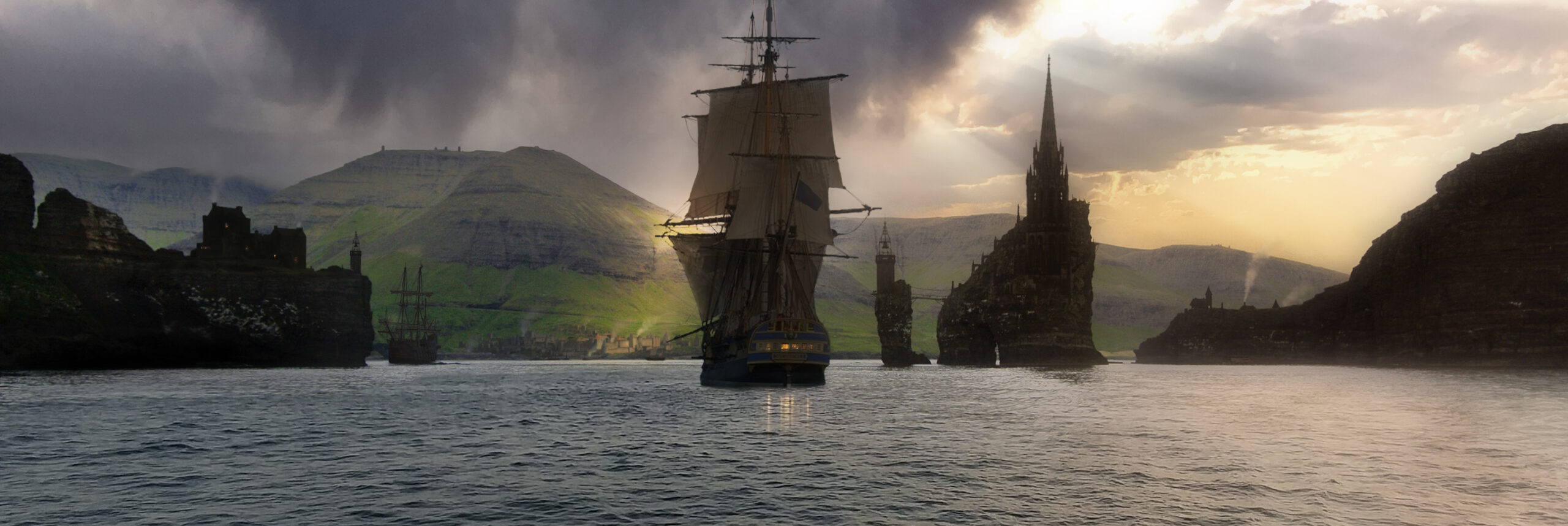
In this interview, we will delve into the creative process of David Brochard, a talented concept artist in the gaming industry. From his early influences to his current work, we will uncover the techniques and inspirations behind his stunning visuals. Get a glimpse into the world of video game art and learn how David’s passion and skills have contributed to the creation of immersive, fantastical worlds. Join us as we delve into the mind of a master artist and discover the story behind his stunning artwork.

Can you tell us about your background and how you got started in the concept art industry?
I trained in a traditional art school and worked as a “trompe l’oeil” and mural painter. This first part of my career allowed me to perfect my technique, to acquire speed and efficiency because, with traditional tools, you can’t cheat!
When I discovered Photoshop, I decided to take a turn in my career; I adapted my knowledge to a new tool and it revolutionized my way of working. I started to work in the digital world with children’s games, as an art director (UNIVERSAL), but my first steps in the concept art world, I made them at Ninja Theory with the game Heavenly Sword for which I was concept artist but also storyboarder, I met there Alessandro Taini and Hugues Giboire who inspired me a lot.

Concept Art for Call of Duty WWII
Can you walk us through your process for creating a concept piece from the initial idea to the final product?
As I work mostly remotely, the most important thing is to understand the brief; for that, I have to get into the mind of the art director. I then propose ideas very quickly.
As I work mostly on very realistic projects, I immediately make images with a lot of details in order to give a maximum of elements to the client to show a direction. I often make several proposals during the day, which allows me to have a rich and argued feedback. Only then, when we agree with the client, I work on the final image with textures, lighting, posings etc…

Concept Art for Dark Souls 3 – Volta
Can you discuss some of your favourite projects you’ve worked on and what you enjoyed most about them?
I really enjoyed working at Volta, a Creative Services studio in Quebec, because I was able to work on many different universes (Call of Duty, Red Faction, Fear, Ghost Recon, Hit Man… ).
Another interesting experience was working on the game Kill Zone Shadow Falls with Guerrilla Games studio; I stayed a long time on this project (about 2 years), which allowed me to immerse myself in this rich universe. I worked on the settings and especially the characters, including the main character. This experience was enriching and quite rare because as a freelancer, my interventions on a project are usually quite short.
I also really enjoyed working for Love Death and Robots with Unit because it was a very creative universe and great team.

Concept Art for Ghost Recon Wildlands – Ubisoft
How do you stay current and continue to improve your skills as a concept artist?
I work as well for video games, cinema or advertising. So I approach many different worlds and I never stay in my comfort zone. I am therefore in permanent research, which allows me to constantly improve my technique. I like to do very different things, because it allows me to expand my field of action infinitely.
I also don’t hesitate to train on new software (Blender, Substance, Unreal… ) to follow the evolution of the industry.

Concept Art Environment for Killzone Shadow Fall – Guerrilla Games
Can you speak of any challenges you’ve faced in your career and how you overcame them?
I challenge myself every day! I think that there is no easy image and that it takes a lot of humility to be a concept artist. You should never hesitate to experiment, start over and always listen to advice, even from less experienced people. You have to work hard to make beautiful images and satisfy the client.

Character Design for Star Citizen – Cloud Imperium
How do you approach collaborating with a team and incorporating feedback into your work?
The most important thing is to listen. Within a team, I am sometimes a source of proposals, sometimes I just listen. I consider myself more of a tool than an artist. We work for an industry, so we have to move fast and be very reactive to feedbacks.

Concept Art for Wolfenstein II – MachineGames
How do you see the concept art industry evolving in the future, and how are you positioning yourself to stay ahead of the trends?
The concept art industry is growing, it is a buoyant sector because entertainment and image take an increasingly important place in our lives and the distribution channels are multiplying. For example, since the arrival of Netflix and other platforms, the production of content is constantly increasing. It’s a chance and it’s very exciting to work in an industry that is constantly evolving.
The tools are also evolving, especially with the arrival of Artificial Intelligence. However, I think that creation is too important for humans to be entrusted to a machine. I remain skeptical about AI because using algorithms to replace man, it allows to lower the costs but it is a soulless and rather cheap creation.
I am lucky to have been able to federate during these years of work many clients (like the Mill, Digital District, Untold,Square…) who trust me more than an algorithm!

Concept Art for Solasta – Tactical Adventures
Can you show and talk about one of your recent works and the inspiration behind it?
Since 2 years, I’ve been working with Graewolv to develop a new IP. I love this experience because I’ve been working there since the very beginning of the project development with a very talented and close-knit team; you have to create everything from scratch and it’s exciting. There is a lot of research work on the architecture; you also have to create original characters and find the style of the game. It is a passionate project!

Concept Art, for Codename Veil (Working Title) – Graewolv